An incurable scribe comes full circle
Judd retools, live on screen

From the Top
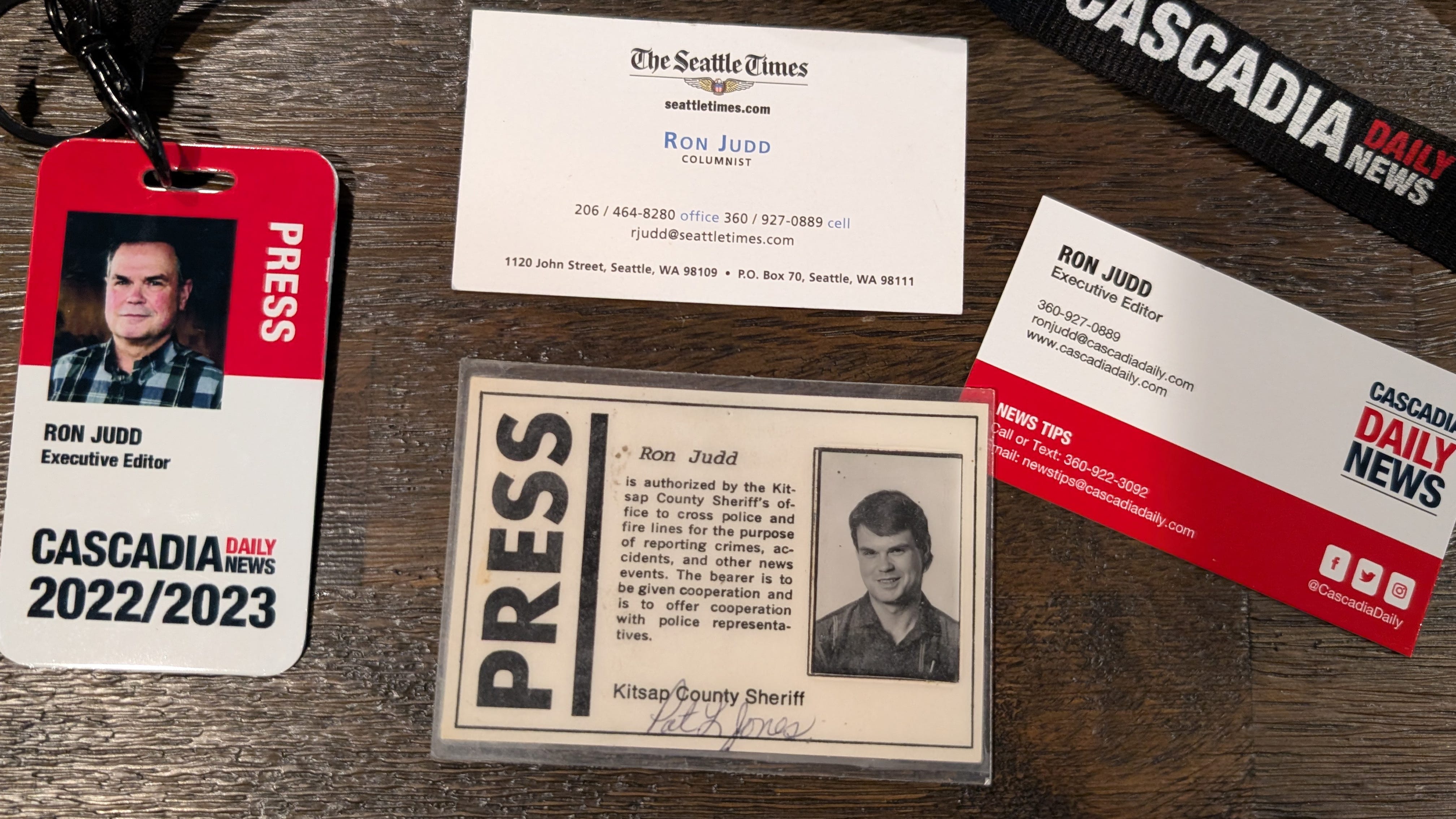
On my big list of Places One Might Experience a Lifetime Milestone, my optometrist’s office was nowhere to be found.
Until a couple weeks ago.
That fateful day, about a week after being fired as a local newspaper editor, I was picking up a new set of Highly Overpriced Progressive Glasses (patent pending) when the desk attendant asked what must’ve seemed an innocent question.
“What do you do for a living again?”
I stared straight ahead, like a daft wildebeest gazing across the river to the other side, not fully cognizant of the sea of emotional crocodiles lurking beneath the surface. Words finally came.
“Uh, nothing, I guess?”
The dude thought this was a funny quip. I found it all mildly terrifying.
I did some math.
For the approximately 47 years prior, I would’ve known the answer to that question, usually offered up with a dollop of self-assured pride: “Journalist.”
Suddenly, blank space.
I’m in my early 60s but not really ready to check the “retired” box. And skipping straight ahead to that memorable George Carlin routine — “Occupation: Fool!” — seemed a bit harsh. (Also, let’s face it, that’s become an increasingly crowded and competitive field in the U.S. over the past decade.)
I’ve since given all this quite a bit of thought. Part of the result is what’s happening in this space (promise: after today’s initial extended throat-clearing, it will typically be more concise).
SOME OF YOU early adopter HammerHeads — bless you one and all for your faith — probably have a sense of where the written trails will lead here. For better or worse. Others, not so much. So, for all of you, a one-time recap of how I got here seems in order.
Journalism has been in my blood since roughly age 16. Having realized by then that writing was one thing at which I did not suck, I took a practical approach: I didn’t see any available community college courses on becoming a great novelist, but journalism seemed an obtainable, mildly honorable, practical career path. It also seemed a great way to exercise some personal demons already cranking on bellows in whatever fires drove me as a youth.
Namely: Righteous indignation over malfeasance, incompetence and puffery, translating into occasional spite for perpetrators of same. And a drive to connect with fellow humans through the craft of writing, especially when said connection elicits emotion on both sides of the chain.
Journalism was a way to actually get paid, albeit not much, for writing.
My choice was burnished one day in a high school freshman English class when the teacher stopped me on my way out the door to lunch.
“I want you to forget about all the assignments in this class,” he said calmly. “Don’t tell anyone.”
“Awesome!” I said, rising to get out while the gettin’ was good. He stopped me again.
“The tradeoff is I want you to spend your hour in class just writing. About anything. About everything. Keep a journal and turn it in to me at the end of the trimester.”
This, to me, was a Willy Wonka Golden Ticket. Within a couple weeks, I was journaling (long before this was even a thing, mind you) not only through that class, but through all the rest of them.
I got an “A,” a rarity for a malcontent who later would team up with a few friends to pick the lock of a school supply room and use ditto-machine equipment to produce, at taxpayer expense, a true underground newspaper, The Malignant Tumor.
Things progressed (slid?) from there. After studying the actual craft at Western Washington University, where the journalism department then was run by serious journalists rather than career CV-padding academics, I headed out into the daily news world in 1985 to save the world from whatever might be attacking it at the moment.
In my mind, if this work involved the exposing of various emperors demonstrably lacking clothing, so much the better. It punched all my buttons, and I loved it, all the way from a community weekly newspaper to a small daily and then a big metro daily, The Seattle Times. There, surrounded by a lot of talent, the work remained so fulfilling that I reinvented myself a half-dozen times to stay in a game that lasted what now seems like a mind-boggling 32 years.
OVER THOSE DECADES I wrote daily news stories about education, government, the environment, sports, food, culture, investigations, mountain climbing, you name it. I spent years serving as that newspaper’s outdoors reporter, a plum assignment in the Pacific Northwest. I assigned myself the role of columnist during that gig. I have kept it ever since.
I parlayed that job into a gig covering the Olympic Games, both summer and winter, for over a dozen years. It took me around the world on someone else’s dime. For a columnist, everything that played out beneath the five Olympic rings was an extremely target-rich environment. I came to adore the gig for its exposure to elite athletes who literally devoted every hour of their lives to achieving one thing, on one day, often in a race or event lasting less than 30 seconds.
I loved the broad spectacle of the Games, which injected me, as a writer, into a traveling human circus. The event always mattered to me as that rare time people from across the globe came together in one place to do something other than try to kill one another.
I eventually came to loathe the corporate greed and corruption that drove the whole show; still do. I couldn’t do it with a straight face today, but I’ll always be glad I did.
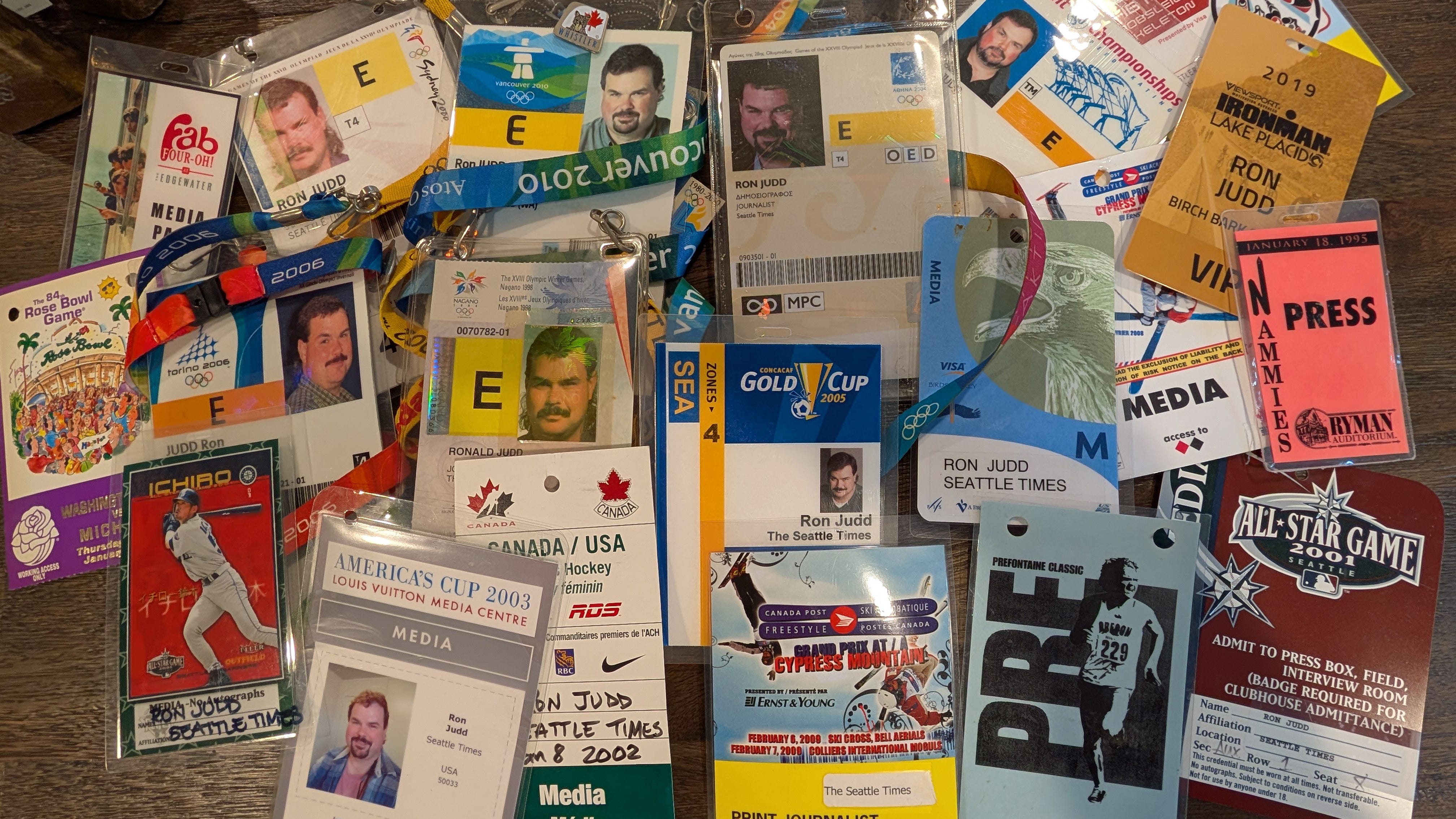
Along the way, The Seattle Times’ then-executive editor, David Boardman, saw a voice in my work that he thought should be unleashed — a decision he might have later come to regret. He commissioned me to write a column in the Sunday newspaper called The Wrap. It was a quick-hitting summation of the week’s event, written with a lot of Jon Stewart-colored satire.
I leapt into it. Readers tended to either love it, hate it, or simply not get it, given the depths to which the time-honored tradition of journalistic satire had plunged in acceptance over the past half-century.
I didn’t care. Somewhat surreptitiously, I made many points in that column, under the cover of humor, about some sacred cows — not to mention any names, such as The Boeing Co., formerly of Seattle — that the paper’s staid editorial board didn’t seem to want to touch. Beat writers at the paper loved the column for this reason, often being gracious enough to let me try out a line or two on them to make sure it was landing correctly. It found an audience, some members of which are still here today.
THAT COLUMN ran for about nine years. When it was ended by the paper, I shifted gears again and took a job as a full-time writer at Pacific NW, one of America’s last surviving newsroom-produced Sunday magazines. It allowed me to choose my own stories, spend weeks reporting with talented photographers, then see my work come alive in full-color splendor created by top-notch editors and designers.
A dream gig. And before it lasted a full decade, I walked away from it. To start a brand new hyperlocal news organization in Bellingham, where I’d lived since 2001. During COVID-19. Between the first and second Trump administrations, and the resulting assaults on the First Amendment. With some decent financial backing, but no real business plan, and no scope of content except for a blank yellow legal pad staring me in the face.
In hindsight, yes, I do realize how insane this sounds.
Skipping over a lot of details here, some of which surely will be infilled later: With the help of some tremendously talented and devoted colleagues, mostly youngsters with little or no experience, that newspaper, Cascadia Daily News, in less than five years turned into a leading news source in its region, garnering national awards for excellence — and more important, a true bond with its community of readers.
I had a fleeting sense of that bond as time went along, but didn’t realize the passion behind it until last month, when I was summarily fired from my job. The outpouring of support for what I had done there — and what everyone in town hopes the newsroom can continue to do — was both surprising and heartwarming.
But the abrupt end to the job that I had loved to the point of preoccupation left me with that big, fat, what’s-next question. And to the moment we are gathered together in this space today, as they say in the wedding biz.
ONE OF MY self-assigned roles at CDN was as an opinionated voice of the newspaper — a role that might not exist moving forward, from the looks of things. This took the form of a weekly personal column and another, unsigned treatise called The Hammer. The name was an ode to its intended punch and the name of the city, Bellingham, from which it originated. By tradition, it was the last thing placed in the Friday print paper every Thursday evening, delivered with much fake pomp from myself to page designer Jaya Flanary, now a CDN managing editor.
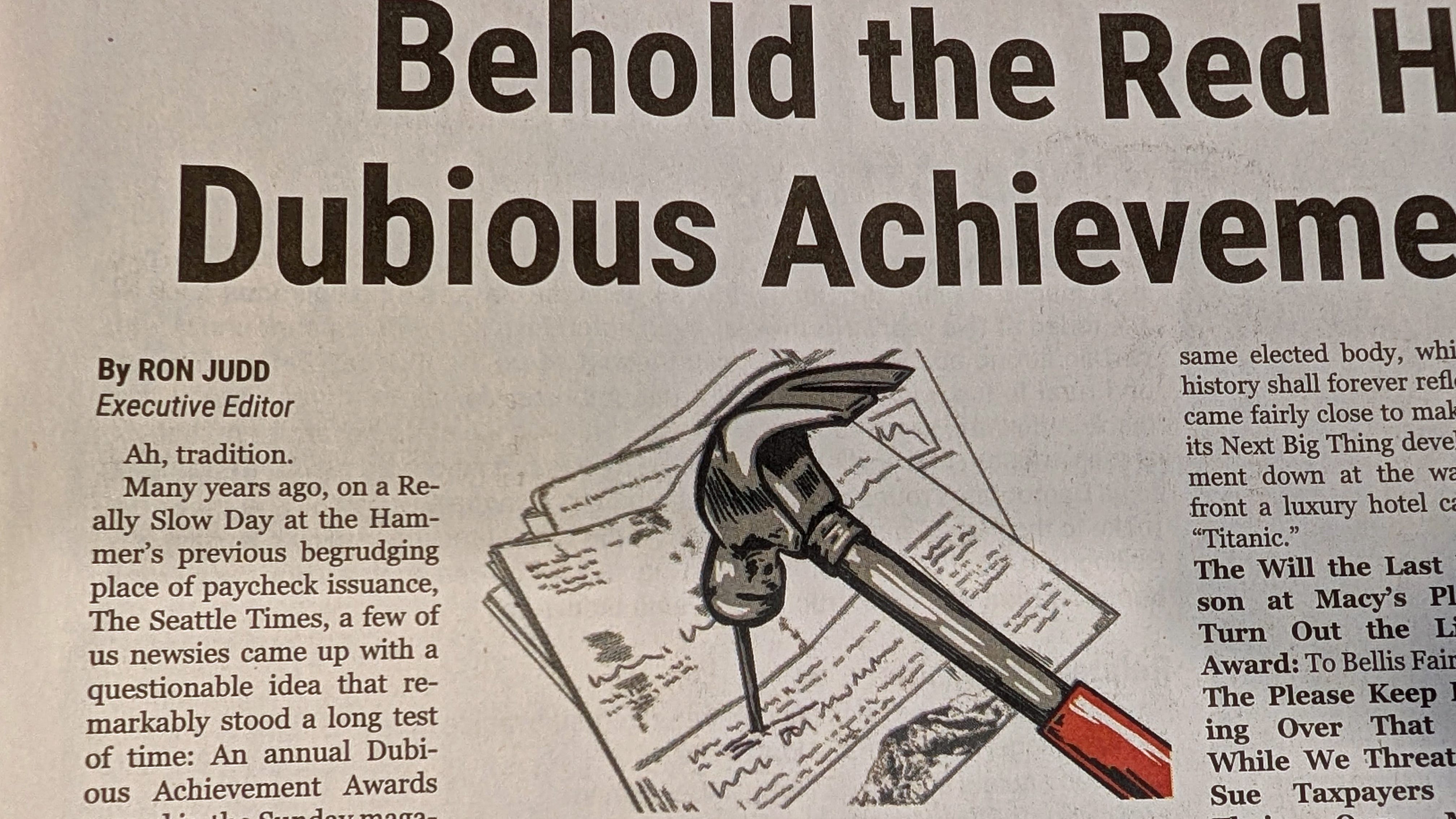
The Hammer, which was retired by the paper upon my dismounting, carried on the legacy of The Wrap, which carried on the tradition of a long string of cheeky, unsigned columns in the American free press going back a couple centuries. This new venture carries the name forward in another fashion. The spirit has never changed.
The BellingHammer is, by design, a work in progress. Is it journalism? Sure. I’m still connected to decades’ worth of sources and know where many NW bodies are buried — or should be. Is it satire? One section of it, at least, every week. Is it wry observation? I suppose so. (Eyes-of-beholder department there.) Is it humor? God, let us hope.
To close the big floppy circle here, I intend for this space to be a new blank canvas, and playing field, for the same impulses that have long driven me. Expect some live reporting, a column-like lead in, a true Hammer section, some pointed media criticism, small-dose political analysis, and, especially, historical context for today’s national mayhem, something that has been a complementary passion, informing some of my best journalism, over my lifetime.
SO HERE I AM, repotting myself once more. It won’t be my only pursuit; a book project or two, one delayed by my Cascadia work, another born from it, might be in the works once I recover from five years of long days at a startup.
But for now, I’m content with a new space to do what I’ve always done. Which was summed up, in beautifully blunt words I might’ve chosen myself, by a local letter-to-the-editor writer, Suzanne Butler of nearby Mount Vernon, who protested my firing thusly:
I depended on him to be an energetic jack-ass about so many things I care about; a good jack-ass, the kind of jack-ass I want in my life. I cried reading his reaction to Yo-Yo Ma’s concert. He gets it, he got it, and I hate that past tense.
I hate it, too, sister. Especially because I lost my job standing up for my newsroom. But so it goes.
I’ve been blessed with opportunities, but pleased to have yet another one here without interference from bean counters who don’t get it.
I’m also pleased to use it as a chance to answer that optometrist’s-office question, next time it comes up, with full authority:
What’s in one’s blood continues to flow. For the rest of my days, just call me a writer.
Anvil
Small, swift blows for sanity struck here weekly
Rockin’ Down the Highway: For a community as generally hip as it is, Bellinghamsters exhibit a curious affinity for fixating on stuff that’s been around for a few decades. (This might be owing to the fact that we’re such a relatively young city that anything more than a few weeks old feels historic; Bellingham’s first colonialists didn’t even arrive here until the 1850s — we know some folks in Boston who have socks older than that.)
The Latest Manifestation: Locals were all abuzz recently when a big, hurking rock that rested along Interstate 5 south of town for a half century — painted with slogans literally thousands of times over the years, like a community billboard — got busted into pieces by the state Department of Transportation to make way for another Highly Dubious Stream Enhancement Project.
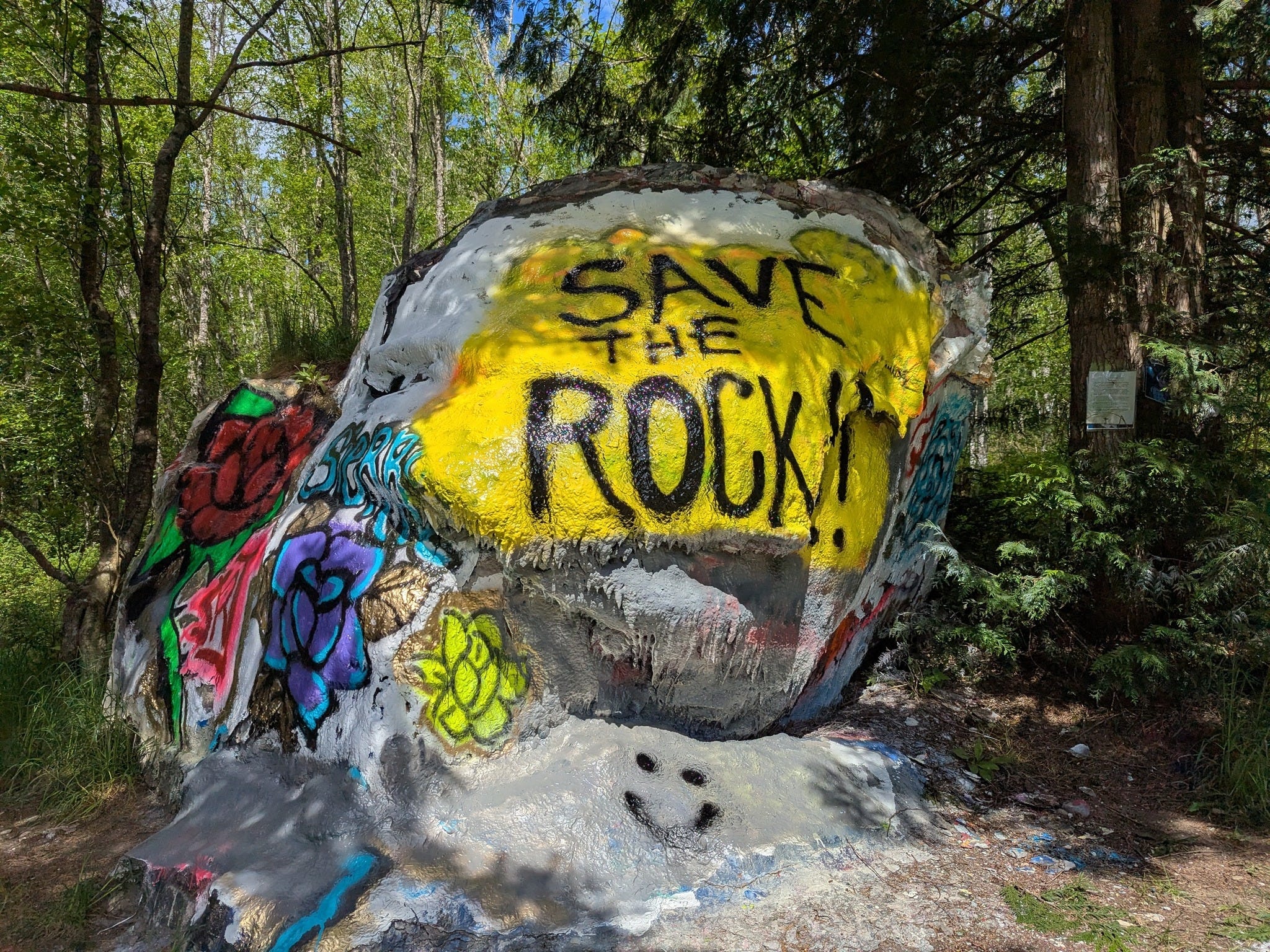
Part of a Pattern: The Great Rock Bust-up of 2026 caused what qualifies in the City of Subdued Excitement as extreme caterwauling in some quarters — approaching the level of angst generated when another unofficial local mascot, a large stuffed sloth placed by unknown miscreants in a tree in the same area, was removed by the same dunderheaded state agency, for no apparent reason.
Thus Spake the Great State of Washington: From a news release this week about The Rock: “Before it was removed, Bellingham Rock was located within the active I-5 construction area at Chuckanut Creek (milepost 247), where contractor crews working on behalf of WSDOT are replacing culverts that block native fish from passing.” (Hammer notes: No convincing evidence that native fish ever passed here; nor likelihood they ever will.) “This work is part of a statewide effort to correct fish passage barriers and comply with a federal court injunction requiring the state to open habitat for salmon and other species.” (Hammer notes: Ah, there you go. What’s $160 million in public funds up in smoke among friends?)
BREAKING (Sorry/Not Sorry) DEVELOPMENT: More than 1,000 pieces (average size, 3 inches), each alleged to be from that former 100-ton boulder, are about to be handed out, like government cheese, to the public for free! It will be a literal Chunk ’o Rock Drive-Thru at the Civic Stadium complex on July 11, with cars queuing up in a large parking lot for a first-come, first-served piece of roadside detritus infamy.
Just Asking: Might it be possible for folks distraught over getting shut out of this rock-dispensation bonanza to get some sort of rain check qualifying them for a branch, twig, discarded soda bottle or large maple leaf sucked up in the agency’s next roadside cleanup? Just trying to look out for everyone here, and keep the recycling wheels turning.
Roll With It, Baby: Amazingly, this project also managed to ring up some high-priced WSDOT legal counsel time. To obtain their piece of The Rock, collectors must digitally sign a please-don’t-sue-the-state waiver, foregoing any rights for damages that might be caused by unauthorized chucking of said stone, or more to the point, from possible ingestion of toxic substances emoting from the 17,000 metric shit-tons of spray paint amassed on the rock over a period of some 50 years. (The state says it stripped all the paint off, but admits rock fragments have not been tested for same.)
Worse Comes to Worst: You can always chuck your commemorative rock in rage at a stoplight at one of the Bellingham major-intersection traffic lights that only turn green on alternate Thursdays. You did not read this here.
Meanwhile, Couldn’t Help Notice: That U.S. Rep. Rick Larsen, D-Sweaty World Cup Scarf, was so busy not rushing to the non-vote on the big Congressional housing measure in the Lesser Washington this week that he had to shoot a social media update on the nonvote from — his moving car? Dude, tell your driver to pull over.
BellingHammmer Suspects: If the Ds don’t get a majority in the fall, leaving the 2nd District Congressman for Life once again as a bystander on committees such as Transportation and Infrastructure, he’ll have ample time to negotiate a deal with Jerry Seinfeld for a spinoff, “Comedians and Congressmen in Cars Getting Coffee and Lamenting Permanent Minority Rule.”
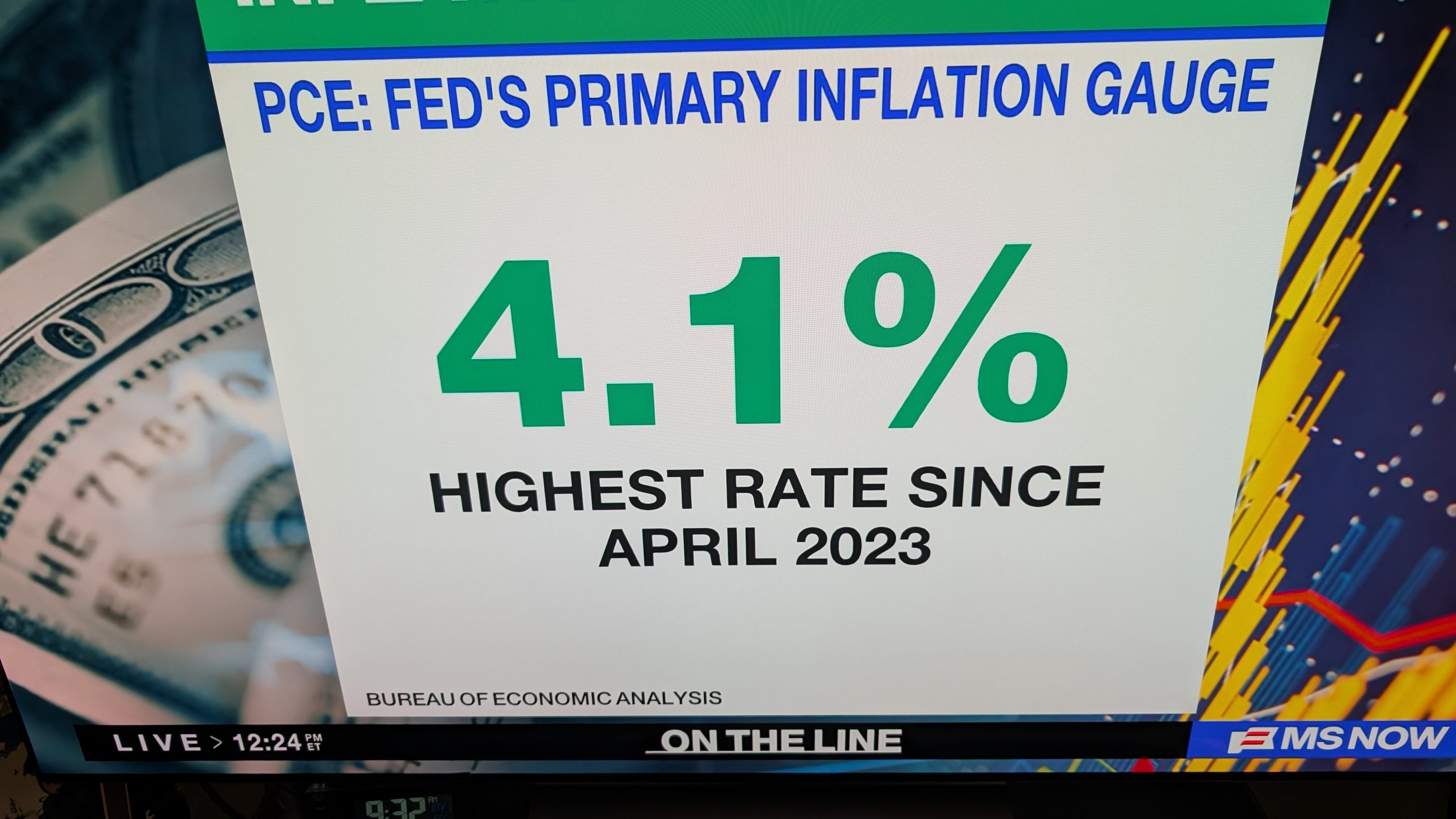
Freudian Slip Department: Alicia Mendez, one of my few remaining preferred TV news journalists, might have been guilty of same on Thursday morning when she announced the latest figures from the “Fed’s Primary Inflation Gouge,” notably at its highest since April 2023. Watchers of that national inflation gauge — a group clearly not including the acting President of the United States — probably would say it works either way.
This Week’s Media Hall ’O Shame
What made America’s great sportswriters America’s great sportswriters? That select group, including one I once sat next to in the press box of the Rose Bowl (Jim Murray) and one who’s an old friend (Art Thiel), always remembered that sports was the toy box of the news world; it was a pleasant diversion from all the rest of the crap being flung your way on a daily basis. Their work slyly acknowledged this from time to time; they connected the playfield with the real world deftly and directly, only when appropriate.
Clearly never receiving that memo are many of the modern practitioners of what once was a great craft. That included, this week, Matt Calkins of The Seattle Times, who on Sunday, June 21, offered up this bit of embarrassing gushing and wanton overreach about the U.S. men’s team’s early performance in the World Cup:
“American patriotism feels like it’s at its 10-year peak — and it’s all thanks to the fever this team is creating on the pitch.”
Seriously?
Step away from the Statue of Liberty hats and get out to where the other 99.998% live, then get back to us, please.
Last Week’s Poll
Opinions were split for my query last week about a chat function for the BellingHammer. Slight edge for “maybe.”
In hindsight, it occurs to me that the question wasn’t explained extremely well. To clarify: Reader comments are always welcome on individual Substack posts; it’s a feature of the platform. I keep an eye on those and respond when I can.
What I referenced was a broader chat function, i.e., topic-specific live chats, that some Substackers use as a premium membership feature. I’m less inclined to go there. But I’ll keep an open mind. Thanks to all who responded.
Workbench
What’s on Bellinghammer’s messy countertops this week
The Seattle Times: “Q&A: New Mexican publisher on newspapers’ future, strength and more,” by Brier Dudley, June 21, 2026. The Times’ Free Press editor ably picks the brain of Patrick Dorsey, chair of the trade group America’s Newspapers, who says “Newspapers are still a damn good business” in spite of all the challenges. “We have to be aggressive, we have to be entrepreneurial, we have to be consistently looking to change, to market ourselves,” Dorsey says. (My own experienced take: Private ownership mixed with supplemental public funding can be a recipe for success in niche markets where demand for high-quality journalism is high — and where strong leadership on a publication’s news side is matched by innovation, industry smarts and a strong public presence on the business side. It’s a model Dorsey sees as continuing to have a strong advantage over fledgling nonprofit-only setups.)
The Seattle Times: “WA’s rich are leaving? Another tax on wealth smashes records,” by Danny Westneat, June 24, 2026. My former colleague at the Seatimes keeps getting right-wingers cranked up in the comments sections by using factual information to counter most of the nonsensical arguments about the detrimental effects of taxation in general, and high-earner income taxing specifically. Proving here that facts, while notably upsetting to some folks, still matter. And the record haul from the state’s capital gains excise tax frankly doesn’t jibe with the canard that such measures drives the rich folks off to another state.
Joe Ely, Silver City, 2007, Rack ’Em Records (CD). The longtime Austin-based crooner was a serious soundtrack-of-my-life person who once appeared onstage in Bellingham for a memorable show alongside kindred spirits John Hiatt and Lyle Lovett. The three of them spoke of being in town for only several hours before feeling the gravitational pull of … what else, The Horseshoe. All of which proved hilarious to a sellout Mount Baker Theatre audience. Great memory, and great folk rock across his career. Ely died in December in Taos and will be missed.
Just want to say that I am a great admirer of your sentences. Also, that English teacher!!! What a gem. Really excited about this newsletter.
Great stuff. Loved your take on caulkins. Not sure how he still as a job. Worst columnist I’ve read.